Democracy sucks.
It's inefficient. There's too much red tape. Nothing ever gets done because people spend most of their time arguing. And since when do people know what's best for them.
No one really knows what's the best way to live life, solve social problems, or be happier. We voluntarily engage ourselves in painful romances, have dessert when we it will make us gain weight, watch TV all day even if we know it's bad for us. Of course someone else should decide for us. Someone who's an expert. There's no better candidate than an expert to run the country. Let's all utilize our comparative advantage. Why think about Social Policy and Taxes when my strength is in computer programming? You shouldn't vote if you don't know anything about politics, right? Let the other people decide. I want to live my life. I don't have time for this bullshit...
And so it goes.
"It has been said that democracy is the worst form of government except all the others that have been tried." - Winston Churchill
We neglect all too often the Human Condition. Consider the following scenario: at a tea-restaurant in Hong Kong, two middle-aged man are swearing at the democratic icons like Martin Lee and Audrey Yu and one of them remarks, "I barely make enough money to live on, how can I be caring about democracy? Can I live on democracy? These politicians are not acting on their consciences, but simply their own interest."
Hong Kong people think like these two middle-aged men because they've never felt danger. Not danger like Bird Flu and SARS. That's nature. We're not talking about nature. We're talking about People. The last time HongKongers were oppressed by another group in the human race was probably in WWII by the Japs. If you've lived life through an oppressive government, you'll value your freedom. You'll start to understand the value of democracy.
The difference between the Pro-Democrats in HK and the rest is that they have Foresight. They can see ahead; they notice the dirty dealings within the CCP. They note how these guys trade with oppressive governments (being one themselves), mass murderers in the name of profit and progress. The CCP probably does the same things, only under the table. That is why the clairvoyants want to protect themselves. They want to protect themselves with a system, and to protect that system with media exposure. We don't have that much time left. 40 years, and the clock's ticking. Before you know it, 2046 comes around and the "50 year" deal is up.
The two men like their status quo. They are resistant to change. It's human nature. They are also protected, optimistic, and tend to believe in the good side of things, people and governments. When something is beyond your intellectual capacity, you want to simplify it. They are short-sighted. Their subconscious cost-benefit analysis is constrained to the short run. If you control for variables, these people probably also tend to gamble, have a low savings rate, and don't have pension plans (if it isn't becoming mandatory).
I don't follow HK politics close enough to advocate democratic change on a pragmatic and policy level. However, I support democracy in theory, even if I don't know when or how it should be implemented. Some people argue that the negative effects of trying to get there outweigh the positive effects of getting there, and some others are even skeptical about there being any positive effects (or difference) at all.
Others cite a survey conducted by HKU, where Anson Chan is leads Regina Yip by 5% for approval rate. They treat this as the dichotomy between "universal suffrage for democractic development" and "relatively pro-beijing/government stance" routes for Hong Kong, trying to show that there is a great divergence among HK people over the issue of implementing Universal Suffrage.
The statistic don't actually say much. It's a number. It would be rash to conclude that it means the HK population is divergent on the OneManOneVote policy. By being so reductionist about politics and society, it's hard to generate meaningful discussion.
It reminds me of Jason's radio debate this summer: the girl on the opposition cited that a majority of Taiwanese people don't want to "return to China", therefore it shouldn't. Political systems have never been implemented democratically. They're implemented by whoever has to power to. The public then conforms to it. If we had good emperors running the country, the lives of people aren't that bad. So why did we abolish that system? Because it is NOT sustainable. The CCP seems to be running China well at the moment. How long has it been? Less than 30 years since China open its doors. And Mao sucked before that.
Have Foresight. Think ahead. Stop Global Warming.
Showing posts with label societal surveillance. Show all posts
Showing posts with label societal surveillance. Show all posts
Tuesday, November 27, 2007


Monday, July 09, 2007
.533 isn't a girl's softball hitting percentage
Quite a lot of people in Hong Kong like to say that there is no need for the city to have Universal Suffrage. A typical argument runs like this: "Hong Kong's economy is growing just fine; why are we making such a big fuss when there aren't any problems?"
Tom Legg puts it nicely,
The comparison of figures over the years (2006 being the highest since we started collecting data in 1971) would not have any siginificance unless calculated in the same manner, and I would hope to believe that the Census Department has considered gross income all along and not switch somewhere on the road.
Hong Kong's tax code hasn't changed dramatically in recent years (to my knowledge), so it seems ludicrous for Ceajer to claim such a thing. No wonder all the legislators launched fire at him after the assertion.
So is this really a problem for Hong Kong? Let's look at the data:
We believe in a free market and free trade because we believe that economics is not a zero-sum game. Some people can fare better without making anyone else worse off. That's the cornerstone of trusting in a free economy. I'm fine with rich people getting richer as long as the poor people aren't getting poorer, but it looks like they are.
The hope that hard work will eventually get us somewhere (Hong Kong's "American Dream) only survives when the belief is true. Don't screw it up, government. And don't just tell me it's a short-run thing and sit back. It's the worst we've got for 37 years. Do something about it.
Tom Legg puts it nicely,
when the folks in Zhongnanhai screw up, the ones to be punished for the mistake are anybody but the folks in Zhongnanhai.There's also the other tiny problem of increasing income inequality
The wealth gap between the rich and poor has widened further with the overall Gini coefficient, representing income disparity, at its highest since the figures were recorded. ...Last year the figure stood at a record high of 0.533, compared with 0.518 in 1996.For comparison,
While most developed European nations tend to have Gini coefficients between 0.24 and 0.36, the United States Gini coefficient is above 0.4, indicating that the United States has greater inequality. Using the Gini can help quantify differences in welfare and compensation policies and philosophies. However it should be borne in mind that the Gini coefficient can be misleading when used to make political comparisons between large and small countries (see criticisms section).Our new Secretary for Financial Services and the Treasury, says this:
Ceajer Chan, however, said last year's figure, with taxation and social benefits considered, had dropped to 0.475, taking it as an "indication for a reduction in the spread of income disparity."While it may be true that disparity among the population's real income (after tax/benefits) is less than that of the gross income (before tax/benefits), that definitely does not infer automatically that income disparity has reduced.
The comparison of figures over the years (2006 being the highest since we started collecting data in 1971) would not have any siginificance unless calculated in the same manner, and I would hope to believe that the Census Department has considered gross income all along and not switch somewhere on the road.
Hong Kong's tax code hasn't changed dramatically in recent years (to my knowledge), so it seems ludicrous for Ceajer to claim such a thing. No wonder all the legislators launched fire at him after the assertion.
So is this really a problem for Hong Kong? Let's look at the data:
For individual workers, the median monthly income for the two lowest groups, or the poorest 20 percent of Hong Kongers, fell by 12.5 percent to HK$3,500.That translates to almost 1,400,000 people whose income fell in the past year.
We believe in a free market and free trade because we believe that economics is not a zero-sum game. Some people can fare better without making anyone else worse off. That's the cornerstone of trusting in a free economy. I'm fine with rich people getting richer as long as the poor people aren't getting poorer, but it looks like they are.
The hope that hard work will eventually get us somewhere (Hong Kong's "American Dream) only survives when the belief is true. Don't screw it up, government. And don't just tell me it's a short-run thing and sit back. It's the worst we've got for 37 years. Do something about it.
Monday, June 25, 2007
Marching for Democracy
Two days ago, I took part (for the first time) in Hong Kong's July 1 Marches.
I believe this is the first time that I actively exercised my civic right to gather, to protest, to express a wish to the government. In 1989 when I was barely 4, I went with my parents to protest against the inhumane measures by the CCP in the Tiananmen Massacre ("Incident"). Now that I'm almost 22, I'm proud to declare a longing for democracy at home, and a will to act on it.
The Economist saw this coming:
What then is my rationale for marching? I believe in substantiating a public voice, the voice that Democracy (universal suffrage) is crucial and inevitable. A simple and powerful reason.
Many people may disagree on when to implement full democracy in Hong Kong, but almost no one would claim that it is unnecessary. This is mainly driven by the fear that CCP's promise of "One Country, Two Systems" will expire in 2047 and drive us from our "undemocratic but free" society towards an "undemocratic and unfree" land.
The CCP's dictatorship will not be contested in Mainland China until it causes widespread hardship and a significant portion of the population is educated. Like in Hong Kong, economic prosperity (or progress) manages to keep a lot of people content and passive.
Although the current government succeeds in maintaining a vibrant economy, our leaders are not chosen by the people. They are appointed by the CCP in a faux democratic manner, resulting in a system that can screw up really bad without an insurance policy. Perhaps the people in the Politburo don't believe in "shock therapy", in that case I'd really like to hear how the "gradualism" plan is like. It feels like the government is performing all sorts of trickery to delay that process.
Hong Kong may not yet be fully mature for democracy, but without taking that first step, it never will be.
Check out these photos, they awakened my social conscience.
I believe this is the first time that I actively exercised my civic right to gather, to protest, to express a wish to the government. In 1989 when I was barely 4, I went with my parents to protest against the inhumane measures by the CCP in the Tiananmen Massacre ("Incident"). Now that I'm almost 22, I'm proud to declare a longing for democracy at home, and a will to act on it.
The Economist saw this coming:
Hong Kong would be a good place to try an alternative way of dealing with dissent. On Sunday, after the fireworks have fizzled and China's and Hong Kong's leaders have told each other how well they are doing, tens of thousands of Hong Kongers will take to the streets to demand their democratic rights. It is fair to predict that they will do so without violence and with considerable good humour. They should be cheered on by everybody who wishes China well."Rally turnout highest for 3 years," say organiser. But not many of my friends at home participated in this march. It wouldn't be far from the truth to say that most of them believe Hong Kong isn't yet ready for democracy. I don't blame them; my family and I would agree. Most people are indifferent to politics until it infringes upon their profits and interests.
What then is my rationale for marching? I believe in substantiating a public voice, the voice that Democracy (universal suffrage) is crucial and inevitable. A simple and powerful reason.
Many people may disagree on when to implement full democracy in Hong Kong, but almost no one would claim that it is unnecessary. This is mainly driven by the fear that CCP's promise of "One Country, Two Systems" will expire in 2047 and drive us from our "undemocratic but free" society towards an "undemocratic and unfree" land.
The CCP's dictatorship will not be contested in Mainland China until it causes widespread hardship and a significant portion of the population is educated. Like in Hong Kong, economic prosperity (or progress) manages to keep a lot of people content and passive.
Although the current government succeeds in maintaining a vibrant economy, our leaders are not chosen by the people. They are appointed by the CCP in a faux democratic manner, resulting in a system that can screw up really bad without an insurance policy. Perhaps the people in the Politburo don't believe in "shock therapy", in that case I'd really like to hear how the "gradualism" plan is like. It feels like the government is performing all sorts of trickery to delay that process.
Hong Kong may not yet be fully mature for democracy, but without taking that first step, it never will be.
Check out these photos, they awakened my social conscience.
Sunday, June 17, 2007
A Stroll in my Backyard
I last blogged in November. It's been so long.
I'm finally back home in Hong Kong and Andy's here to visit. Today we walked first from Causeway Bay to the Golden Bauhinia Plaza in Wanchai, and then roamed on foot from Central to Sai Wan via the Central-Mid-Levels escalators. The trudge took about 3 hours, but was a fruitful sociological voyage with some quality photos as proof.
 It's a Sunday and Father's Day so it was more crowded than usual on the streets, but a special thing about Sundays in Hong Kong is the sudden appearance of a large Domestic Helper population. The group is overwhelmingly foreign and female, consisting mainly of Filipinas but with increasing numbers of Indonesians and Thais. On their day off, they pour out onto the streets to form their once-a-week community, conglomerating at the city's scarce public spaces, seeping into the nooks and crannies of Hong Kong's financial district, the place where their congregation causes the least nuisance.
 The world-renowned HSBC bank design by Norman Foster includes a ground floor plaza open to public even when the bank is closed (a concept I took note of in my studio project). Consequently, the entire space is neatly populated every Sunday without fail, yet leaving ample pedestrian space for people like us to pass through. It's almost a sociological exhibition to stroll around Central on a Sunday.
 The plaza space is theoretically lightened up by mirrors that direct sunlight through a giant atrium space, but I don't think I've ever seen it work very well. The idea seems similar to Solatube, a natural lighting solution for interiors that have few windows, but the latter seems more successful in its execution. Granted though, it is limited to structures that have a roof, not a privilege shared by many Hong Kong spaces.
 As we moved further away from the glass and steel of the commercial district, we progressed from lumps of high-rises sprinkled with old buildings to conglomerates of tenement housing speckled with tall ugly beasts. The two extremes of Hong Kong architecture depict the severe and ongoing problem of income disparity in the city. Nonetheles, most HK people are lucky (relative to the world); most of them have a home, a job and enough to live on despite the minimal amount of social security support from the government.
 Other urban problems persist. The lack of open/public/green space is a big issue that is difficult to tackle. Land is gold in this city. 7 million people occupy 1000 square kilometers, with three-quarters of that land actually being the country parks. Green oases are a breathing relief in this wonderful but suffocating concrete mess, but their future is bleak while the government envisions 10 million people to live in this city. That said, green parks or public plazas are rarely found and if so, only utilized by the elderly. The younger public clusters in air-conditioned malls (perhaps rightly so in the hot and humid weather), subconsciously engaging in conspicuous consumption.
 This theory of leisure is shaped in large part by structural factors that are controlled disproportionately by politics and economics. You need a committed, charismatic and insistent political leader to fix this externality. Or instill a Pigovian subsidy for architectural designs that provide widely accessible open/green spaces. The sky is still visible, yet the concrete plague advances slowly but surely.
 Perhaps we need to begin to follow in Chicago's footsteps.
(Not) All photos courtesy of Andy Chen.
I'm finally back home in Hong Kong and Andy's here to visit. Today we walked first from Causeway Bay to the Golden Bauhinia Plaza in Wanchai, and then roamed on foot from Central to Sai Wan via the Central-Mid-Levels escalators. The trudge took about 3 hours, but was a fruitful sociological voyage with some quality photos as proof.
 It's a Sunday and Father's Day so it was more crowded than usual on the streets, but a special thing about Sundays in Hong Kong is the sudden appearance of a large Domestic Helper population. The group is overwhelmingly foreign and female, consisting mainly of Filipinas but with increasing numbers of Indonesians and Thais. On their day off, they pour out onto the streets to form their once-a-week community, conglomerating at the city's scarce public spaces, seeping into the nooks and crannies of Hong Kong's financial district, the place where their congregation causes the least nuisance.
  The world-renowned HSBC bank design by Norman Foster includes a ground floor plaza open to public even when the bank is closed (a concept I took note of in my studio project). Consequently, the entire space is neatly populated every Sunday without fail, yet leaving ample pedestrian space for people like us to pass through. It's almost a sociological exhibition to stroll around Central on a Sunday.
  The plaza space is theoretically lightened up by mirrors that direct sunlight through a giant atrium space, but I don't think I've ever seen it work very well. The idea seems similar to Solatube, a natural lighting solution for interiors that have few windows, but the latter seems more successful in its execution. Granted though, it is limited to structures that have a roof, not a privilege shared by many Hong Kong spaces.
  As we moved further away from the glass and steel of the commercial district, we progressed from lumps of high-rises sprinkled with old buildings to conglomerates of tenement housing speckled with tall ugly beasts. The two extremes of Hong Kong architecture depict the severe and ongoing problem of income disparity in the city. Nonetheles, most HK people are lucky (relative to the world); most of them have a home, a job and enough to live on despite the minimal amount of social security support from the government.
  Other urban problems persist. The lack of open/public/green space is a big issue that is difficult to tackle. Land is gold in this city. 7 million people occupy 1000 square kilometers, with three-quarters of that land actually being the country parks. Green oases are a breathing relief in this wonderful but suffocating concrete mess, but their future is bleak while the government envisions 10 million people to live in this city. That said, green parks or public plazas are rarely found and if so, only utilized by the elderly. The younger public clusters in air-conditioned malls (perhaps rightly so in the hot and humid weather), subconsciously engaging in conspicuous consumption.
  This theory of leisure is shaped in large part by structural factors that are controlled disproportionately by politics and economics. You need a committed, charismatic and insistent political leader to fix this externality. Or instill a Pigovian subsidy for architectural designs that provide widely accessible open/green spaces. The sky is still visible, yet the concrete plague advances slowly but surely.
  Perhaps we need to begin to follow in Chicago's footsteps.
(Not) All photos courtesy of Andy Chen.
Friday, November 03, 2006
(Perhaps) The Most Heroic Job...... Ever
A long time ago (almost a year now) I blogged about the moviefilm "The Constant Gardener". Not an attractive movie title, I admit, but an absolutely amazing film which highlights some extremely pertinent social issues while preserving the highest aesthetic quality possible.
 I wrote, at the time,
 Should the guinea pig option not be a voluntary activity, open for participation to people from all places by providing compensation (aka cash incentive) for the risk? Risk is inevitable in a fireman's job, yet there are plenty of people who willingly take up the job. Same goes for policemen. Drug testing is as heroic a job as theirs. Volunteers accept a certain amount of risk by helping to save people in the future. Surely that job should merit an amount of respect such that the applicant pool for firemen and policemen would consider it.
That said, I know that Africans will end up as the guinea pigs because the cash incentive (*cough* wage) would be the lowest. I wonder: if one day we are able to outsource dangerous jobs like firefighting to poorer countries (e.g. via teleporting), will we have any more firefighters in rich countries?
We are, in the end, just outsourcing "guinea pig" jobs to Africa.
 I wrote, at the time,
"Pharmaceutical companies test drugs for side effects on Africans who are going to die anyway, either of HIV, or of the many other dieseases that are easily treatable if only there were the resources. Hopefully, no one will tell me that these companies are doing a good thing by making sure those drugs will work for us. But would you use such a drug if you'd die without it? What if you didn't know about the exploits? How can we stop the illicit acts of these profit-driven corporations? They are motivated merely by the "golden" economic laws of supply and demand..."David Friedman (Milton's son) suggests in "Drugs for Africa: A Modest Proposal" to
1) Let charitable donors in rich countries buy out the patent on the second best AIDS drug or combination of drugs and public domain it—let anyone who wants make it.The first suggestion is a sound idea, both pragmatic and socially beneficial. However, the second proposal really bothers me, despite the lack of a feasible alternative. According to Friedman, people like me will
2) Make FDA [design] rules on testing so as to encourage drug companies to make not yet approved drugs available abroad in order to use the information so generated to meet the requirements for approval in the U.S.
[Make] good demagogic use of the idea that it is wicked to use human beings as guinea pigs for potentially dangerous drugs—despite the fact that using humans as guinea pigs is the only way we have of finding out whether or not drugs are safe.The fallacy is why should people with less money be the only ones targeted as guinea pigs? If we believe in universal human rights, then the status of a human being in Zambia should be no less than one in Arkansas, Faroe Islands or Timbuktu. Why are some lives put at risk so that others can benefit?
 Should the guinea pig option not be a voluntary activity, open for participation to people from all places by providing compensation (aka cash incentive) for the risk? Risk is inevitable in a fireman's job, yet there are plenty of people who willingly take up the job. Same goes for policemen. Drug testing is as heroic a job as theirs. Volunteers accept a certain amount of risk by helping to save people in the future. Surely that job should merit an amount of respect such that the applicant pool for firemen and policemen would consider it.
 That said, I know that Africans will end up as the guinea pigs because the cash incentive (*cough* wage) would be the lowest. I wonder: if one day we are able to outsource dangerous jobs like firefighting to poorer countries (e.g. via teleporting), will we have any more firefighters in rich countries?
We are, in the end, just outsourcing "guinea pig" jobs to Africa.
Saturday, October 21, 2006
Food For Thought
- from gregmankiw.blogspot.com
Defense spending in the US is shrinking as a general trend in recent years...
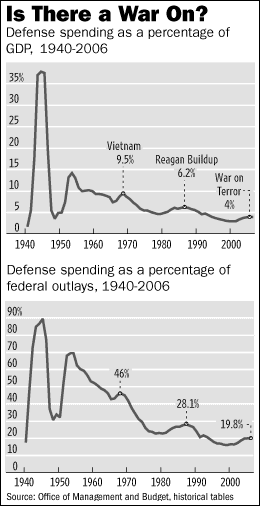
...yet that budget is still the largest of any country in the world.
What's wrong with that?
Defense spending in the US is shrinking as a general trend in recent years...
...yet that budget is still the largest of any country in the world.
What's wrong with that?
Tuesday, October 10, 2006
Issues Back Home
R.I.P. Posi Noni (1961-2006)
The common name Friedman succeeds in capturing my attention. Thomas Friedman - The World is Flat. Milton Friedman - Permanent Income Hypothesis. So when lucid writer Milton writes an Op-Ed titled "Hong Kong Wrong", I invariably take some time out to read what he has to say:
Administrative costs will reduce that revenue on a grand scale, and further decrease Hong Kong's allure as an investment location. From ordinarygweilo.com:
The common name Friedman succeeds in capturing my attention. Thomas Friedman - The World is Flat. Milton Friedman - Permanent Income Hypothesis. So when lucid writer Milton writes an Op-Ed titled "Hong Kong Wrong", I invariably take some time out to read what he has to say:
Hong Kong's policy of "positive noninterventionism" was too good to last. It went against all the instincts of government officials, paid to spend other people's money and meddle in other people's affairs.My question is: although politicians are paid to spend and meddle, surely there is an incentive to be paid and do nothing, given that there has historically been a grander justification than indolence. I am all for advocating a 'conspiracy' (if it's not painfully obvious) of PRC interference.
Mr. Tsang insists that he only wants the government to act "when there are obvious imperfections in the operation of the market mechanism." That ignores the reality that if there are any "obvious imperfections," the market will eliminate them long before Mr. Tsang gets around to it. Much more important are the "imperfections"--obvious and not so obvious--that will be introduced by overactive government.A disappointment from Tsang. Is the introduction of the GST (Goods & Services Tax) such an action to "obvious imperfection"? Perhaps if the government is running out of funds for its lavish projects, it should reflect on whether it is being, as Friedman points out, overly active. "Broadening the tax base" seems a euphemism for not wanting to piss off the very rich. Instead, civil servants are worried that funds for their pensions are not secured, thus wanting to push the GST bill quickly through LegCo.
Administrative costs will reduce that revenue on a grand scale, and further decrease Hong Kong's allure as an investment location. From ordinarygweilo.com:
[The GST] will also mean (in theory at least) that if you buy goods outside Hong Kong you would have to pay GST when bringing them into Hong Kong - well, good luck with enforcing that at Lo Wu, chaps. As well as the extra civil servants need to collect and enforce this tax, there will be additional costs for private firms to administer and forward the tax to the authorities - and you can bet that these costs will be passed on to consumers. In addition, exporters will need to pay GST and then claim it back.Not only will Hong Kong no longer be a "shining symbol of economic freedom", it seems that the prying fingers of Zhong Nan Hai are tightening their grip. The future of Hong Kong hangs upon several threads (connections in trade, human capital, economic prosperity); as they break one by one, and as we are scrambling to make feeble ones to keep it hanging, universal suffrage is crucial, and how HK negotiates that with China. Friedman's still waiting for a verdict:
The ultimate fate of China depends, I believe, on whether it continues to move in Hong Kong's direction faster than Hong Kong moves in China's.I'm hoping to watch Wong Kar-Wai's 2046 in a few weeks.
Monday, September 04, 2006
Protectionism - Brought to a New Level
While the US and Europe are still widely criticized for stalling Doha talks with their insistent farm subsidies, and while the US Senate is still trying to pass the 27.5% tariff on Chinese imports, nothing tops the ridicule of this protectionist move.
An American school banned the wonderful International Baccalaureate (IB for short) because:
Perhaps this kind of protectionism (preventing CNOOC from acquiring Unocal) is justifiable through strategic interest (though personally I think the Senate was just soiling their pants at China's surging power), but surely America's public, or those in power, should realize USA's comparative advantaage lies not in its farmers, its factories and mass production, or its standardized tests, but rather in its abundance of bright minds and resources, which it should channel towards the development of science and technology.
Without innovation, the US of A would falter in the 21st century.
An American school banned the wonderful International Baccalaureate (IB for short) because:
officials condemned it as "un-American" and Marxist, sparking outrage among pupils who are studying the increasingly popular diploma.They also rejected it on grounds that it is anti-Christian (note: World Religions) and that it is "too foreign". Check this out:
Trombetta, the board member who has received death threats from angry parents, had further complained that the IB tests "were developed in a foreign country".I understand the concern for maintaining AP's integrity, but as a country that prides itself on its Capitalist society and progress from competition, simply rejecting a foreign yet widely successful curriculum will not automatically guarantee the success of America's children. If anything, in this increasingly global and flat world, America's next generation will simply continue to possess their narrow world view that has not been beneficial at all.
Perhaps this kind of protectionism (preventing CNOOC from acquiring Unocal) is justifiable through strategic interest (though personally I think the Senate was just soiling their pants at China's surging power), but surely America's public, or those in power, should realize USA's comparative advantaage lies not in its farmers, its factories and mass production, or its standardized tests, but rather in its abundance of bright minds and resources, which it should channel towards the development of science and technology.
Without innovation, the US of A would falter in the 21st century.
Thursday, August 31, 2006
If You're Young and Not Left
you have no heart.
Being a lefty, an inevitable groan arises when faced with the comment "lefthanded people are more intelligent/creative/weird" from people using it as some sort of desperate conversation starter. The countless stories or assertions by enthusiastic mothers have trained me to be desensitized by these comments, despite the amount of truth or falsehood it consists.
Turns out that according yet another recent study by economists (supposedly trained statisticians), lefties (among college graduates) really do earn more than their peers.
Most "normal" people out there are probably thinking, "What a load of bs." Levitt (author of Freakonomics), a righty, thinks likewise:
What a load of crap. I (6' lefty) will be the anomaly that proves the rule.
...if you're old and not right, you have no brain.
Being a lefty, an inevitable groan arises when faced with the comment "lefthanded people are more intelligent/creative/weird" from people using it as some sort of desperate conversation starter. The countless stories or assertions by enthusiastic mothers have trained me to be desensitized by these comments, despite the amount of truth or falsehood it consists.
Turns out that according yet another recent study by economists (supposedly trained statisticians), lefties (among college graduates) really do earn more than their peers.
Most "normal" people out there are probably thinking, "What a load of bs." Levitt (author of Freakonomics), a righty, thinks likewise:
Because I am not left-handed, I have never taken much pleasure in the endless parade of studies, articles, and anecdotes about how left-handed people are better at everything than right-handed people.What's more, tall people also have an above average salary not because of societal preferences, height dominance or self-esteem building, but simply because they are - smarter (according to this study).
What a load of crap. I (6' lefty) will be the anomaly that proves the rule.
...if you're old and not right, you have no brain.
Tuesday, August 29, 2006
When I Look At The World...
You have dreams. You have ideals. You want to help. You want to make a difference.
That's all you ever wanted. Heal the world. Or just do something. Feed the malnourished. Vaccinate the sick. Educate the illiterate. Lend a hand to the handicapped, the elderly, the socially disadvantaged, the unfortunate. Give a leg up to immigrants, refugees, minimum wage families, the unemployed. Sounds so good and altruistic, doesn't it?
 Well, it never is as easy as it sounds. Nothing ever is. I certainly haven't heard of anything that is. Perhaps I'm just skeptical. I used to be idealistic, in the not too distant yet already far away past. I still am, but reality runs you over, mashes you up the way a bullet train grazes through hamburgers.
Selling girl scout cookies? Raising money for a breast cancer fund? Keeping old people company? Doing immigrant children's homework over the phone? Maybe it helps. Maybe it doesn't. And I'm probably leaning towards the negative. Why?
3 reasons: high OC, dramatic BP, and often unattractive LES.
Opportunity Cost - volunteers waste an exorbitant amount of their talent and time in the process of charity work. Smart volunteers could usually effect more change through the inherent job nature or simply by donating their high wages The humanitarian efforts are worth something if and only if the program or project is run in an extremely smooth manner - which rarely happens.
 Bureaucracy & Politics - charity organizations, like any other sizable group, have plenty of administrative problems to worry about, yet they lack the quintessential incentive to maximize productivity since they are often non-profit parties. They usually attempt to have many layers of decision-making in order to divide up the labor, yet more often than not result in completely pointless job titles and altogether ineffective governing.
Leadership Efficiency Scale - only idealistic yet intelligent people can mold volunteering into a worthy (aka profitable) venture. And those people choose (based on the 1st reason) to contribute through other channels, perhaps due to the high level of investment (and low return) required at the beginning stage. Moreover, resources (both human and monetary) are almost never devoted in the most efficacious way possible, where help is needed the most or where the most help can be done. Even charity follows 'Economies of Scale'.

My lesson from Pinghu : Summer 2006.
Compassion alone is not enough.
That's all you ever wanted. Heal the world. Or just do something. Feed the malnourished. Vaccinate the sick. Educate the illiterate. Lend a hand to the handicapped, the elderly, the socially disadvantaged, the unfortunate. Give a leg up to immigrants, refugees, minimum wage families, the unemployed. Sounds so good and altruistic, doesn't it?
 Well, it never is as easy as it sounds. Nothing ever is. I certainly haven't heard of anything that is. Perhaps I'm just skeptical. I used to be idealistic, in the not too distant yet already far away past. I still am, but reality runs you over, mashes you up the way a bullet train grazes through hamburgers.
 Selling girl scout cookies? Raising money for a breast cancer fund? Keeping old people company? Doing immigrant children's homework over the phone? Maybe it helps. Maybe it doesn't. And I'm probably leaning towards the negative. Why?
3 reasons: high OC, dramatic BP, and often unattractive LES.
Opportunity Cost - volunteers waste an exorbitant amount of their talent and time in the process of charity work. Smart volunteers could usually effect more change through the inherent job nature or simply by donating their high wages The humanitarian efforts are worth something if and only if the program or project is run in an extremely smooth manner - which rarely happens.
 Bureaucracy & Politics - charity organizations, like any other sizable group, have plenty of administrative problems to worry about, yet they lack the quintessential incentive to maximize productivity since they are often non-profit parties. They usually attempt to have many layers of decision-making in order to divide up the labor, yet more often than not result in completely pointless job titles and altogether ineffective governing.
 Leadership Efficiency Scale - only idealistic yet intelligent people can mold volunteering into a worthy (aka profitable) venture. And those people choose (based on the 1st reason) to contribute through other channels, perhaps due to the high level of investment (and low return) required at the beginning stage. Moreover, resources (both human and monetary) are almost never devoted in the most efficacious way possible, where help is needed the most or where the most help can be done. Even charity follows 'Economies of Scale'.

My lesson from Pinghu : Summer 2006.
Compassion alone is not enough.
Friday, June 23, 2006
Cross, Crescent, and Crystal
Israel and Palestine joined the Red Cross today, after 100 years of symbolic dispute. This kind of ideological debate often stands in the way of an ideal, efficient world. The ideology is also what keeps us living in the first place.

The Telegraph reports:
The Telegraph reports:
For about 50 years the Israeli society had been excluded from the International Federation of Red Cross and Red Crescent Societies because of its insistence on using a red Shield (or Star) of David.Ethical (or bureaucratic) ideology is just as prevalent as the religious kind.
At the same time, the Palestinian Red Crescent Society was excluded because the movement's statutes permitted only relief societies from sovereign states to join.So much easier this way. Now they've finally agreed on a neutral symbol. One in which they'll insert the Cross/Crescent at the appropriate settings.
The so-called "Red Crystal" - a red square standing on its corner - will now take its place alongside the Red Cross and the Red Crescent as an internationally-recognised humanitarian emblem.I wonder what the symbol for Hospital will become?
Wednesday, June 14, 2006
Cups and Bucks
The World Cup frenzy is all over the world. Which team will get to carry the biggest honor of their lives home, and which others will have to settle with a 3-minute cup? Even if you're not into spectator sports, or any sports at all for that matter, you may still find it impossible to distance yourself sufficiently enough from the all the hype.
Intense speculation from gamblers and non-gamblers alike have often led to interesting outcomes. Brazil is by popular opinion the big 'hot door', but personally, it is quite likely that this will happen again.

For those with economic flair and an interest in soccer, you might find Greg Mankiw's Blog: The World Cup to be stimulating.
According to this list, the countries up there do indeed have a higher FIFA ranking. Heck, when the US is 8th in GDP per capita and 5th in FIFA rankings, what can you say? Yet, *surprisingly* Luxembourg tops the GDP ranks but its soccer team is nowhere to be seen.
The other anomaly is that Brazil ranks 74 in GDP per capita and Argentina is 67th, while they are respectively the 1st and 9th in the FIFA rankings. Interesting of note, however, is that the rankings for total nominal GDP for Brazil and Argentina rise to 11th and 34th, which better reflect the general correlation between Football (Soccer) performance and having the big bucks.
The general correlation seems to ignore the outliers and obliterates the question of causality. Even though there may be plausible theories related to opportunity cost, income effect, substitution effect and so on, the biggest factor in play here is customer preference. In some places, people love football. They live, feed and die on football, while Americans misunderstood it as another sport and funnily enough, enjoy bumping into each other all the time.
Finally, a few pointers from Elaine on how to choose a team to support (especially if you're a 'football widow' AND all of the above bores you AND you managed somehow to survive till here). My favourite is this:
Intense speculation from gamblers and non-gamblers alike have often led to interesting outcomes. Brazil is by popular opinion the big 'hot door', but personally, it is quite likely that this will happen again.
For those with economic flair and an interest in soccer, you might find Greg Mankiw's Blog: The World Cup to be stimulating.
Goldman's figure...shows a strong correlation between World Cup ranking and GDP per person. Being rich and having a good team go hand in hand.
According to this list, the countries up there do indeed have a higher FIFA ranking. Heck, when the US is 8th in GDP per capita and 5th in FIFA rankings, what can you say? Yet, *surprisingly* Luxembourg tops the GDP ranks but its soccer team is nowhere to be seen.
The other anomaly is that Brazil ranks 74 in GDP per capita and Argentina is 67th, while they are respectively the 1st and 9th in the FIFA rankings. Interesting of note, however, is that the rankings for total nominal GDP for Brazil and Argentina rise to 11th and 34th, which better reflect the general correlation between Football (Soccer) performance and having the big bucks.
The general correlation seems to ignore the outliers and obliterates the question of causality. Even though there may be plausible theories related to opportunity cost, income effect, substitution effect and so on, the biggest factor in play here is customer preference. In some places, people love football. They live, feed and die on football, while Americans misunderstood it as another sport and funnily enough, enjoy bumping into each other all the time.
Finally, a few pointers from Elaine on how to choose a team to support (especially if you're a 'football widow' AND all of the above bores you AND you managed somehow to survive till here). My favourite is this:
8. support the team wearing your favourite colour
unfortunately it could be a bit rare to come across a team in pink.
Subscribe to:
Posts (Atom)